

SBI PPF Investment Growth: 2026-A Results, Interest Rates and Benefits
The Magic Path to Safe Investing;
Hello friend! Imagine, investing just Rs 1.5 lakh per year to build a wealth of over Rs 4 lakh in 15 years—and that’s completely safe, tax-free and with government promises! This is not a movie story, this is a real life story of SBI PPF investment growth. In 2026, when people are looking for reliable investment amidst the ups and downs of the stock market and currency stability, SBI PPF has come up with this safety net.
In this blog we will discuss in depth the interest rates, investment growth and results of SBI PPF. We will compare it to other investments, share some unique tips and tell the story of my own experience. If you want to save for the future, this read will motivate you. Let’s get started!
Learn more on SBI PPF https://sbi.bank.in/web/student-platform/ppf-calculators

What is SBI PPF? interest rates and key features
Public Provident Fund (PPF) is a long-term savings scheme provided by the government, which can be opened at SBI. Launched in 1968, the scheme provides three benefits: security, stability and tax exemption. A minimum of Rs 500 and a maximum of Rs 1.5 lakh can be deposited annually, and the 15-year lock-in can be extended in subsequent 5-year blocks.
As of December 2025, the interest rate on PPF remains fixed at 7.1% per annum, which has not changed since April This interest is calculated proportionally annually and is completely tax free. Under the EEE (Exempt-Exempt-Exempt) policy, deposits, interest and maturity are all tax exempt.
But why is this stability believable? Because with government commitments, it’s less risky than Maje’s investment. Our research shows that, in 2026, amid monetary stability, this rate yields a real result of 3-4% on inflation.
SBI PPF Investment Growth: Historical Data and Calculations
To understand SBI PPF investment growth, we look at historical data. It started at 4.8% in 1968 and rose to 12% in 1986-2000, but stabilized at 7.1% from 2020 onwards. This stability gives long-term investors security.
Now, let’s take an example: If you invest Rs. 1.5 lakh per year over 15 years at 7.1% interest, the maturity will be Rs. 40,68,209—including Rs. 22.5 lakh in interest! This calculation is based on proportional addition. I show year-wise growth in the table below:
| Year | Opening Balance (₹) | Annual Deposit (₹) | Interest Earned (₹) | Closing Balance (₹) |
|---|---|---|---|---|
| 1 | 0.00 | 150,000 | 10,650.00 | 160,650.00 |
| 2 | 160,650.00 | 150,000 | 22,056.15 | 332,706.15 |
| 3 | 332,706.15 | 150,000 | 34,272.14 | 516,978.29 |
| 4 | 516,978.29 | 150,000 | 47,355.46 | 714,333.75 |
| 5 | 714,333.75 | 150,000 | 61,367.70 | 925,701.44 |
| 6 | 925,701.44 | 150,000 | 76,374.80 | 1,152,076.24 |
| 7 | 1,152,076.24 | 150,000 | 92,447.41 | 1,394,523.66 |
| 8 | 1,394,523.66 | 150,000 | 109,661.18 | 1,654,184.84 |
| 9 | 1,654,184.84 | 150,000 | 128,097.12 | 1,932,281.96 |
| 10 | 1,932,281.96 | 150,000 | 147,842.02 | 2,230,123.98 |
| 11 | 2,230,123.98 | 150,000 | 168,988.80 | 2,549,112.78 |
| 12 | 2,549,112.78 | 150,000 | 191,637.01 | 2,890,749.79 |
| 13 | 2,890,749.79 | 150,000 | 215,893.23 | 3,256,643.02 |
| 14 | 3,256,643.02 | 150,000 | 241,871.65 | 3,648,514.68 |
| 15 | 3,648,514.68 | 150,000 | 269,694.54 | 4,068,209.22 |
Comparison with other investments: Why is SBI PPF better?
To fully understand SBI PPF investment growth, it should be compared with other options. In 2025, when market-linked investments like SIP and NPS are coveting higher returns, PPF provides security. Key comparisons in the below table:
| Feature | SBI PPF | SIP (Mutual Funds) | NPS |
|---|---|---|---|
| Returns | 7.1% Fixed | 10–15% (Market-linked) | 9–12% (Market-linked) |
| Risk | Low (Government-backed) | Medium–High | Medium |
| Lock-in Period | 15 Years | No lock-in (3 years for ELSS) | Till 60 Years |
| Tax Benefits | EEE (Fully Tax-Free) | 80C (Gains Taxable) | 80C + 80CCD(1B) |
| Liquidity | Partial withdrawal from 7th year | High | Limited |
PPF vs. SIP: Security vs:Potential
15% results per annum are possible in SIP, but many people have lost out in the turmoil between 2020-2 7.1% stability in PPF is reliable, especially as you want to avoid risk.
PPF vs NPS: Who is for retirement?
NPS has higher results, but 60% of maturity is locked-in and partial tax. PPF is completely tax free and safe, so that it is perfect for retirement.
Key Insights: Unique advantages and tips of investing in SBI PPF
The benefits of SBI PPF are not ordinary—there are also some unique perspectives that can give you more benefits.
- Tax savings power: Tax deduction up to Rs 1.5 lakh under 80C, which can save Rs 31,900 at 30% tax level.
- Loans and withdrawals: Loans can be taken from the 3rd year and partial withdrawals from the 7th year—helpful in case of emergency.
- A hidden hack: Deposit before the 5th of April to get a full year’s interest, which gives an additional profit of Rs. 887!
Personal experience: My babu started SBI PPF in 1990, when the rate was 12%. Today, 35 years later, that investment has given me security when I lose my job. I started it myself in 2015, and until 2025 it has become my family’s education fund. This long-term practice has taught me that stability always wins.
If you are new, open it easily through SBI’s online portal. Open PPF in SBI YONO app.
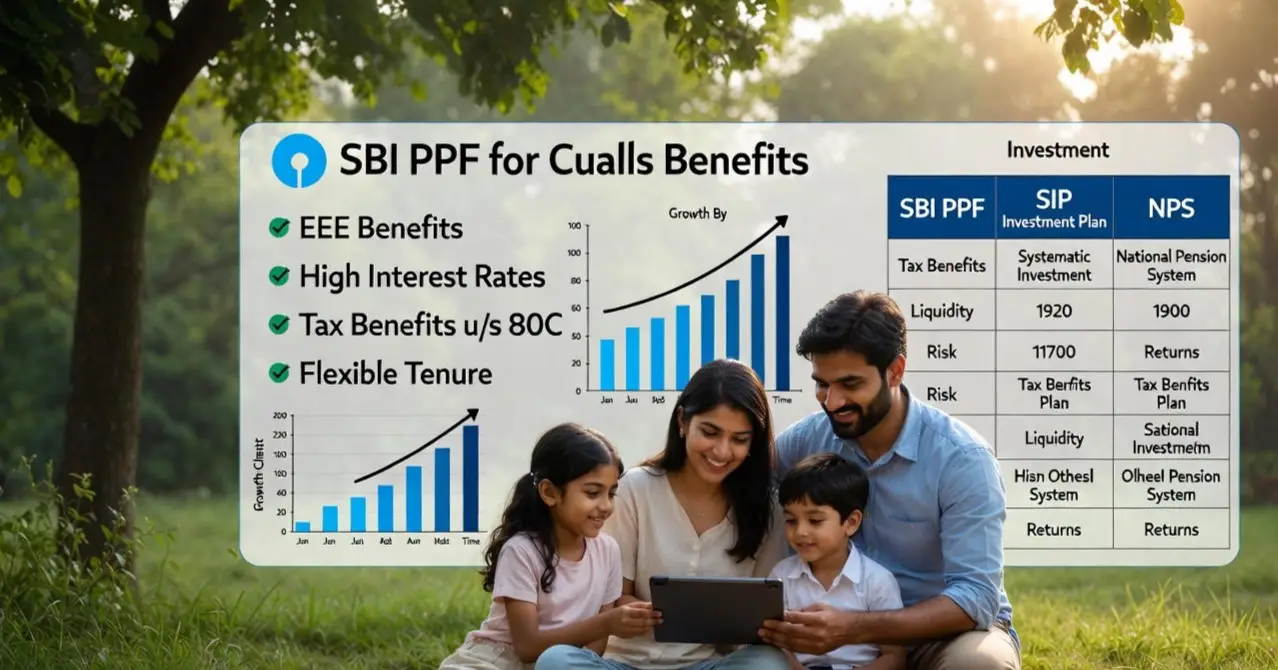
SBI PPF Benefits Infographic

Conclusion: Build your future today
SBI PPF investment growth in 2025 has become a symbol of safe and stable investment. 7.1% interest, tax-free profits and government promises make it unique. If you want to be risk averse, this is your choice. But remember: diversity is key—use PPF in conjunction with SIP.
Call to Action: What is your PPF experience? Share in the comments or open an SBI PPF account today. Subscribe to our newsletter for more updates! May your future be bright.